
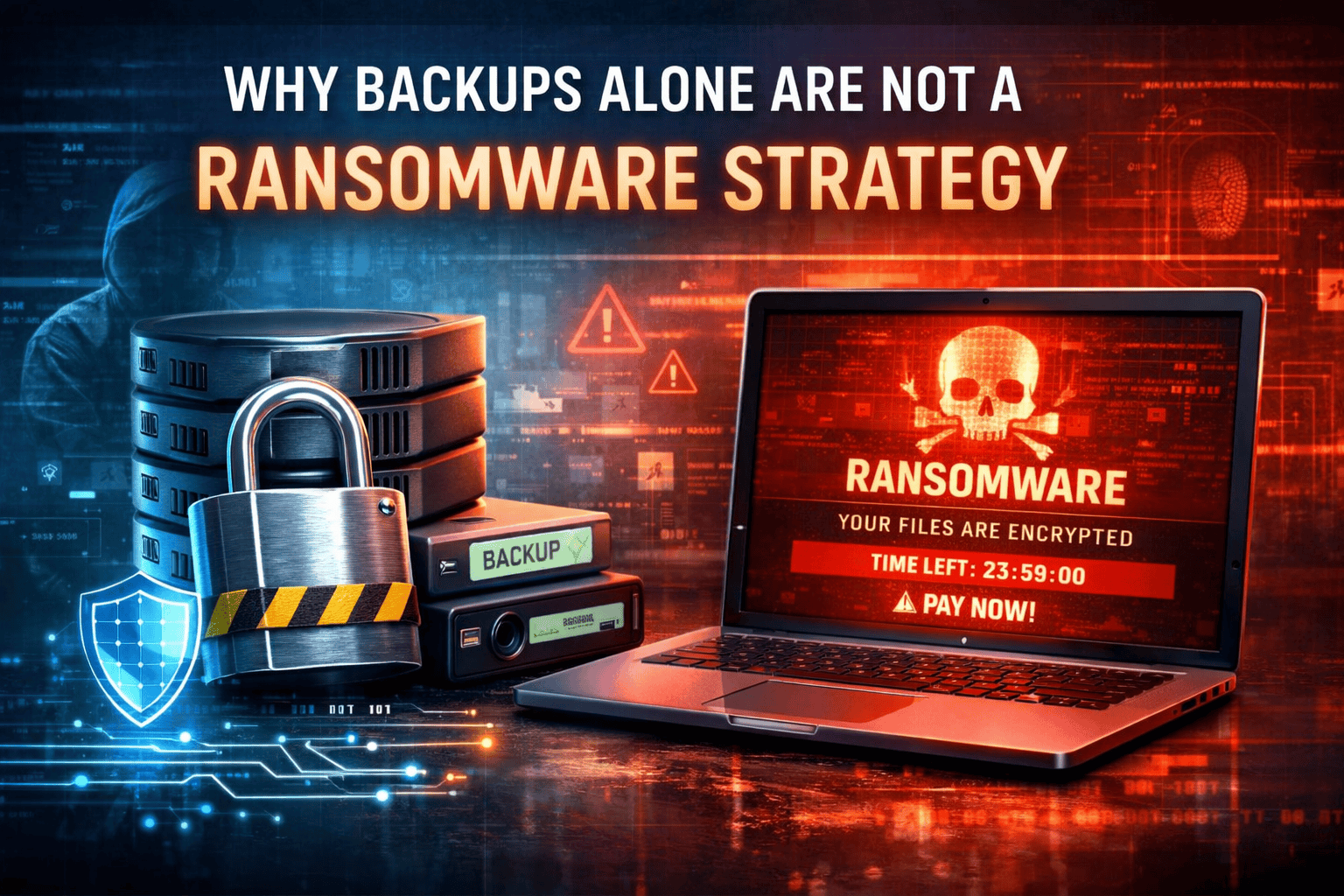
Why Backups Alone Are Not a Ransomware Strategy
For years, the go-to answer to ransomware has been simple: “We have backups.” While backups are a critical part of any cybersecurity program, relying on them as the primary ransomware defense is a dangerous oversimplification. In today’s threat landscape, backups alone are no longer enough.
Modern ransomware attacks are no longer smash-and-grab operations. Attackers are patient, deliberate, and strategic. Once inside a network, they often spend days or weeks performing reconnaissance—identifying critical systems, locating backup infrastructure, and escalating privileges. By the time ransomware is deployed, attackers frequently know exactly where backups live and how to disable or encrypt them first.
From a NIST Cybersecurity Framework (CSF) perspective, this is a failure of the Protect and Detect functions. If attackers can move freely, access backup systems, and operate undetected for extended periods, the organization is already operating at a disadvantage long before encryption begins.
Even when backups survive an attack, recovery is rarely quick or painless. Restoring large environments can take days or weeks, during which business operations may be severely disrupted. For many organizations, especially small and mid-sized businesses, extended downtime can be just as damaging as data loss itself. Missed revenue, lost customers, regulatory penalties, and reputational harm can far outweigh the cost of the ransom.
This is where Incident Response (IR) and Disaster Recovery (DR) planning intersect. Backups support recovery, but without a defined incident response process—who makes decisions, how systems are isolated, when recovery begins—organizations often lose valuable time. In NIST terms, the Respond and Recover functions are just as critical as prevention.
Another common misconception is that any backup is a good backup. Traditional backups that are writable, online, and accessible with standard administrative credentials are prime targets. If attackers compromise a domain admin account—and many do—those backups are often compromised right along with everything else. Without protections like immutability, offline copies, or strict access controls, backups may offer a false sense of security.
Testing is another overlooked weakness. Many organizations assume backups will work because they always have. But backups that are never tested may be incomplete, corrupted, or unusable when they’re needed most. From a DR standpoint, an untested restore is not a plan—it’s a hope. NIST’s Recover function explicitly emphasizes the importance of validated recovery processes and continuous improvement.
A resilient ransomware strategy focuses on survivability, not perfection. This includes layered defenses such as endpoint detection and response (EDR), least-privilege access, network segmentation, and continuous monitoring. It also requires tabletop exercises and incident response testing so teams are prepared before a real event occurs.
Backups remain essential, but they should be treated as a last line of defense, not the first. Organizations should invest in immutable or offline backups, restrict access to backup systems, monitor for suspicious activity, and regularly test recovery procedures. Just as importantly, leadership must understand that cybersecurity resilience is a business issue—not just an IT responsibility.
In ransomware incidents, the question is no longer “Can we recover our data?” It’s “Can we continue operating?” Backups help—but only as part of a broader strategy aligned with NIST CSF, Incident Response, and Disaster Recovery best practices.